When I started my AI learning journey, I knew there were many tools out there, but I wasn’t sure which one would actually help me the most. This week, I decided to take three popular AI assistants — ChatGPT, Perplexity, and Gemini — for a test drive.
My goal? To see how they perform on the same questions, find their strengths and weaknesses, and figure out which ones might be most helpful for beginners.
If you’re just getting started with AI, I hope this post gives you a clear, no-jargon introduction to these tools and helps you decide which one to try first.
What Is an AI Assistant?
An AI assistant is a tool that can understand your questions, generate answers, and help with tasks like writing, research, or creative brainstorming — all in natural language. Think of it as having a super-knowledgeable helper on your phone or computer that’s ready whenever you are.

Meet the Three AI Assistants I Tried
1. ChatGPT (OpenAI)
- Best for: Creative writing, idea generation, step-by-step explanations.
- Strengths: Very conversational, creative, and beginner-friendly.
- Weaknesses: Without web browsing enabled, some info can be outdated.
2. Perplexity AI
- Best for: Real-time web-connected research, fact-checking, summarizing.
- Strengths: Always up-to-date, provides citations for easy verification.
- Weaknesses: Less “chatty” and creative compared to ChatGPT.
3. Gemini (Google AI)
- Best for: Integrating with Google tools, quick answers, and visual search.
- Strengths: Good at breaking down tasks and integrating search and productivity features.
- Weaknesses: Responses can feel text-heavy and less concise for quick scanning.
How I Tested Them
To make it fair, I asked each AI the exact same three questions in separate chats:
- Explain AI to a 10-year-old (testing simplicity & clarity)
- Plan a 3-day trip to Seoul, South Korea (testing practical planning skills)
- Give me three Instagram post ideas for gadget review (testing creativity & relevance)
My Results and Observations
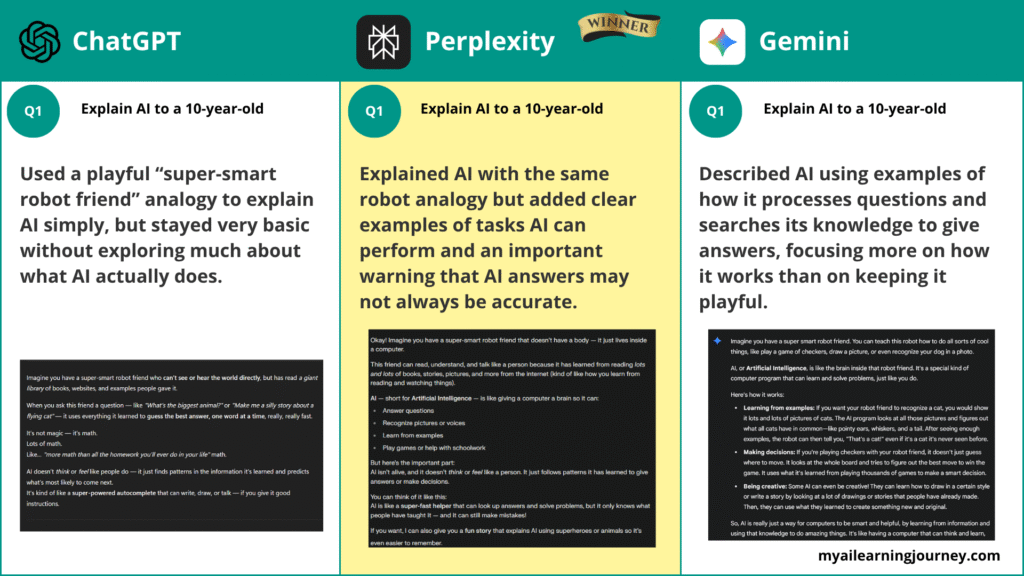
1. Explain AI to a 10-year-old
- ChatGPT: Simplest explanation, but felt like it was aimed at a child with little interest in AI.
- Perplexity: Explained what AI can do and included an important point — that AI information isn’t always accurate. This is a valuable lesson to share even with kids.
- Gemini: Focused more on how AI works with examples.
Winner for me: Perplexity — because it included the accuracy disclaimer and balanced clarity with useful details.
2. Plan a 3-day trip to Seoul, South Korea
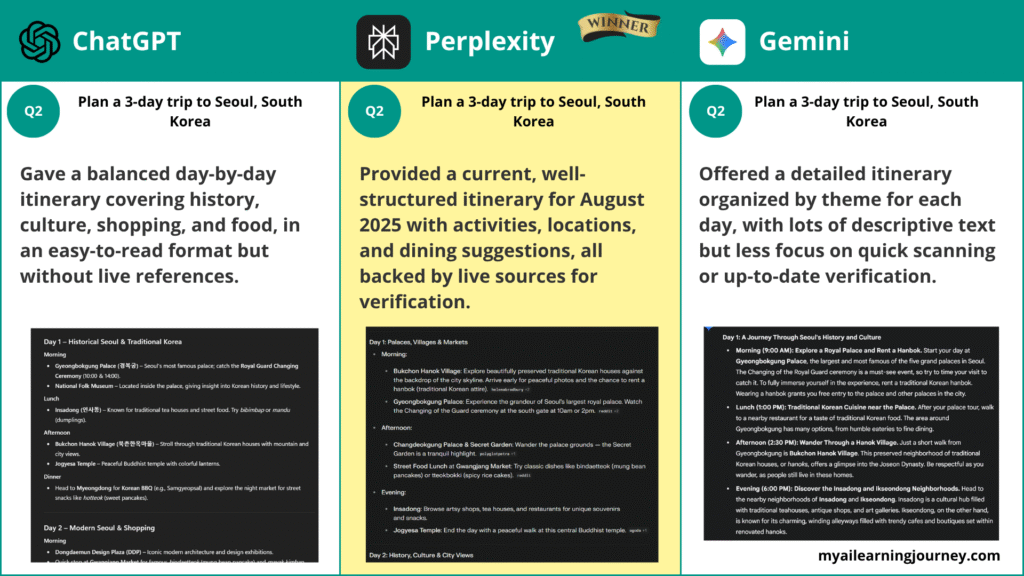
- ChatGPT: Easy-to-read format with practical tips, but no live citations.
- Perplexity: Clear, well-structured itinerary for August 2025, with live sources for every recommendation so I could check accuracy without Googling separately.
- Gemini: Good details, but very text-heavy, making it harder to scan quickly.
Winner for me: Perplexity — the combination of current info and citations made it the most useful.
3. Give me three Instagram post ideas for gadget review
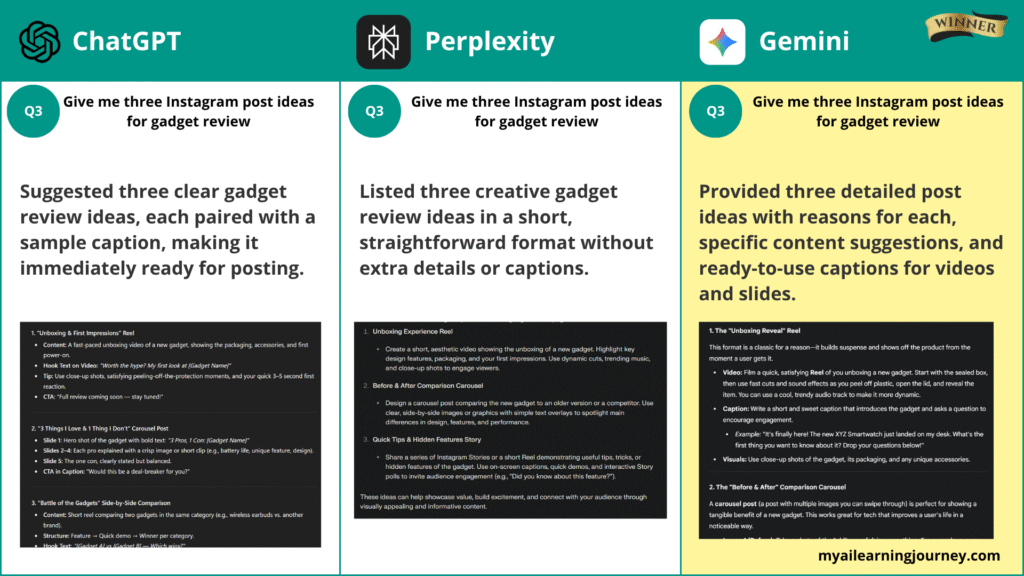
- ChatGPT: Simple, with captions included.
- Perplexity: Gave just the ideas — concise and on-point.
- Gemini: Most detailed, with reasons for each idea, suggested formats, and captions.
Winner for me: Gemini — because it explained why each post idea would work and gave specific creative details.
What I Learned
- Prompting matters — vague questions will still get decent answers, but better prompts get better results.
- No single “best” tool — each one has its own strengths and weaknesses.
- Use the right tool for the right job —
- For creative writing and step-by-step explanations, go with ChatGPT.
- For up-to-date, well-sourced information, use Perplexity.
- For detailed content planning with reasons, Gemini works well.
Final Thoughts
If you’re a beginner, don’t worry about picking just one AI assistant. Instead, try them out, see how they respond to your style of questions, and match the tool to the task.
AI isn’t here to replace curiosity — it’s here to fuel it. The more you experiment, the more you’ll understand how each tool can become part of your daily workflow.